

10 consumer PR agencies to consider in 2026
A verified shortlist of consumer public relations agencies, plus the questions that help you choose the right partner for your brand.
The best consumer PR agency is not the one with the longest awards shelf or the most familiar logos in its pitch deck. It is the one with relevant category experience, an account team you trust, a clear measurement plan, and a working style that fits yours.
This list is a starting point, not a podium. We included agencies with a current official website, identifiable consumer-brand capabilities, and enough published information to understand where they may fit. We did not rank them by company size, fame, or who wrote the most dramatic homepage copy.
Agency structures change. Services change. The team that wins your pitch may not be the team that handles your account. Verify the current details and meet the day-to-day team before signing anything.
A consumer public relations agency helps brands reach and influence the people who buy, use, recommend, or talk about their products.
The work may include:
- consumer and lifestyle media relations;
- product launches and review programmes;
- creator and influencer campaigns;
- brand positioning and storytelling;
- events, partnerships, and cultural activations;
- crisis and reputation work;
- social, digital, and content strategy;
- campaign measurement and reporting.
Consumer PR differs from corporate PR mainly in audience and context. A corporate communications programme may focus on investors, employees, regulators, and executive reputation. Consumer PR usually focuses on customers, culture, products, and the channels that influence buying decisions. Large agencies often handle both, which is useful when a product issue can become a corporate reputation issue before lunch.
For a broader explanation of agency services, read what a PR agency does.
We looked for evidence on the agency's own current website, including a consumer or brand practice, relevant services, published work, sector coverage, or named examples. Inclusion does not mean Prezly has audited client satisfaction, pricing, staffing, or campaign performance.
The agencies below vary considerably. Some are global networks built for multinational brands. Others offer a smaller or more specialist operation. The right shortlist depends on your market, category, risk, budget, and internal team.
They are listed alphabetically. There is no secret number-one agency lurking behind a methodology-shaped curtain.
Best fit: You want an independent US communications firm combining earned media with digital, influencer, paid, reputation, and newer AI-search services.
5W describes its current model as an integrated communications stack covering earned media, crisis and reputation, executive visibility, content, social, influencer programmes, performance marketing, and media planning. Its site positions the agency around both traditional media attention and visibility in search and AI-generated answers.
That breadth may suit a consumer brand that wants one partner across several channels. Ask how those disciplines share one strategy in practice, which capabilities are delivered by the account team, and which are separate scopes or specialists.
Best fit: Cultural relevance, brand positioning, retail integration, partnerships, and consumer education are central to the brief.
Allison has a dedicated consumer brands practice covering brand building, repositioning, product launches, cause marketing, media relations, retail integration, partnerships, sports marketing, and trend-led work. The agency also publishes its own cultural-intelligence frameworks.
This is a potentially good fit for brands that need more than product publicity. During the pitch, ask the agency to show how its cultural insight changes the campaign plan, not merely the slide template.
Best fit: You need an integrated consumer agency with media relations, creative, digital, experiential, intelligence, and crisis capabilities.
Citizen describes itself as a global PR firm with offices in Canada, the United States, and the United Kingdom. Its own guidance for consumer brands stresses integrated services, cultural relevance, creator work, experiential marketing, intelligence, and crisis preparedness.
That mix can suit brands whose consumer reputation spans retail, media, social platforms, live experiences, and fast-moving public issues. Ask which offices and specialists would work on your business and how multinational work is coordinated.
Edelman brand marketing and communications
Best fit: You are a large or multinational brand needing research, brand strategy, creator programmes, experiential work, multicultural marketing, and corporate reputation support.
Edelman's brand practice covers brand strategy, storytelling, content, influencer marketing, experiences, partnerships, media relations, and multicultural engagement. It also has dedicated consumer packaged goods experience across food and beverage, personal care, apparel, household products, and consumer technology.
Scale brings resources, but it also makes team structure important. Ask who will make strategic decisions, who will run the account each week, which markets are included, and how conflicts between clients in similar categories are handled.
FINN Partners consumer and lifestyle
Best fit: Your brand sits in lifestyle, food and beverage, retail, travel, outdoor, fashion, beauty, luxury, consumer technology, or CPG.
FINN publishes a dedicated consumer and lifestyle practice covering consumer PR, content, digital marketing, influencer programmes, advertising, crisis communications, and retail campaigns. Its sector material includes recent work and practice areas across several consumer categories.
The broad category coverage is useful, but category depth should still be tested. Ask for recent work from the specific team proposed for your account, in the countries and channels that matter to you.
Best fit: You need a large global agency spanning brand and consumer work, corporate affairs, food and nutrition, health, and technology.
Golin and Ketchum combined in 2026 and now operate as Golin Ketchum. That makes older lists treating them as two separate agencies out of date. The combined agency publishes specialist practices including Brand & Consumer and describes an integrated global operating model supported by data and AI capabilities.
The merger may expand the available bench, but clients should ask practical questions about the resulting structure. Which legacy or combined team will handle the work? Have reporting lines changed? How are existing client conflicts and local-market responsibilities managed?
Best fit: You want a communications partner centred on earning attention and building reputation for consumer companies and brands.
HUNTER describes itself as a strategic and creative marketing communications partner working with brands internationally from New York and London. Its positioning is firmly brand- and consumer-facing.
The public homepage is concise, so the pitch process needs to do more of the evidentiary work. Ask for current category-specific case studies, the proposed account team, the balance between earned media and broader marketing services, and sample reporting.
Best fit: Your consumer work intersects with purpose, behaviour change, health, food, nutrition, technology, public priorities, or corporate reputation.
Porter Novelli publishes services across brand communications, media relations, influencer relations, launches, campaigns, events, corporate reputation, and purpose. Its sector coverage includes food, agriculture and nutrition alongside health, technology, corporate and government work.
That combination may suit consumer brands operating in scrutinised or regulated categories. Ask how sector specialists, creative teams, and reputation advisers would work together on your brief.
Best fit: You want a New York-based agency and can verify that its current consumer, ecommerce, product, or launch experience matches your category.
RLM publishes case studies covering consumer products, ecommerce, fragrance, arts and crafts, entertainment, education technology, and financial services. Its site emphasises a fast, proactive approach and measurable results.
Some of the case studies are older, so recency matters. Ask which consumer clients the proposed team has worked with during the past 18 months, which journalists they currently pitch, and what a relevant first 90 days would look like.
Best fit: You need global scale, integrated brand and reputation work, cultural strategy, creative campaigns, and access to specialists across sectors and markets.
Weber Shandwick positions itself as an earned-first global agency supported by advisory, creative, data, technology, and AI capabilities. Its published sectors include food, healthcare, technology, and finance, while its work includes major consumer brands and public-facing campaigns.
For a large network, scope and staffing deserve as much attention as credentials. Ask which office owns the relationship, how senior involvement is protected, and what work requires other agencies within the wider network.
Do not begin with agency names. Begin with the problem.
Write down what should be different after six or twelve months. That could include stronger product-launch coverage, more relevant reviews, improved brand understanding, greater share of voice in a category, better crisis readiness, or clearer reporting across earned and creator activity.
Then assess each agency against the same criteria.
Ask for recent work involving brands at a similar stage, in a similar market, with similar audiences and risks. A famous campaign for a global drinks company may tell you little about how the agency will launch an early-stage homeware brand in Belgium.
Request live coverage links and current references where appropriate. Check that the journalists and publications remain relevant to your category.
Meet the people who will work on the account every week. Clarify their roles, seniority, location, availability, and other client commitments.
A polished pitch led by senior directors is not especially useful if they vanish immediately after procurement signs the agreement. Magic tricks should at least involve a rabbit.
A good agency should ask about the business, audience, distribution model, margins, launches, constraints, competitors, and previous PR activity before prescribing a campaign.
Be wary of a ready-made plan delivered before the agency understands the problem. That is a template with your logo on it.
Ask which journalists, creators, communities, and outlets matter, and why. Strong answers should be more specific than "top-tier media".
Relationships help, but relevance, timing, evidence, and a useful story still matter. Nobody owns a journalist, regardless of how impressive the contact database looks during the pitch.
Agree on outcomes and reporting before work starts. Coverage volume alone rarely tells the whole story.
Depending on the brief, useful measures may include:
- coverage quality and message inclusion;
- relevant referral traffic;
- branded search demand;
- share of voice against named competitors;
- creator content and audience response;
- product samples requested or reviewed;
- event registrations or enquiries;
- sentiment and recurring narrative themes;
- crisis response readiness and speed.
Avoid treating advertising value equivalency as proof of PR value. Ask to see a sample report and the decisions the agency expects to make from it.
Confirm what is included, what costs extra, and what depends on a third party. Cover approval times, out-of-hours work, travel, paid creator fees, production, monitoring, wire distribution, and crisis support.
Also clarify who owns contact data, campaign materials, newsroom content, analytics, and work created during the engagement. Read renewal and termination terms before everyone is tired and wants the meeting to end.
Our PR agency evaluation checklist gives you a more detailed scoring framework. For a formal pitch process, use a clear PR agency RFP so each firm responds to the same brief.
Ask every shortlisted agency:
- Which recent consumer-brand assignments are most similar to ours?
- Who will work on our account day to day?
- Which audiences, journalists, creators, and channels would you prioritise first?
- What would you need from our internal team to succeed?
- What should the first 30, 60, and 90 days produce?
- How will you measure progress against our business and communications goals?
- How do you handle product claims, regulated topics, and reputational risk?
- What work is included in the retainer, and what is billed separately?
- How do you handle conflicts with clients in the same category?
- What happens to our contacts, content, reporting data, and accounts if the relationship ends?
The answers should reveal how the agency thinks, not merely how many case-study slides it has accumulated.
Slow down if an agency:
- guarantees earned coverage;
- avoids introducing the day-to-day team;
- presents old or irrelevant case studies as current proof;
- cannot explain why specific media or creators matter;
- reports only impressions, clip counts, or advertising value equivalency;
- proposes tactics before understanding your goals and constraints;
- is vague about fees, third-party costs, or contract renewal;
- expects to own your contact database or published content without a clear reason;
- treats every announcement as newsworthy;
- discourages you from speaking with references.
A confident agency can explain what it is good at, where it is not the right fit, and what it cannot guarantee.
Hire an agency when you need expertise, relationships, geographic coverage, production capacity, or temporary scale that would be slow to build internally.
Build in-house when communications is continuous, institutional knowledge is critical, and you can support the necessary strategy, media relations, content, measurement, and crisis skills over time.
Many brands use a hybrid model. The internal team owns strategy, approvals, company knowledge, and long-term relationships. The agency brings specialist skills, campaign capacity, market access, and an outside view.
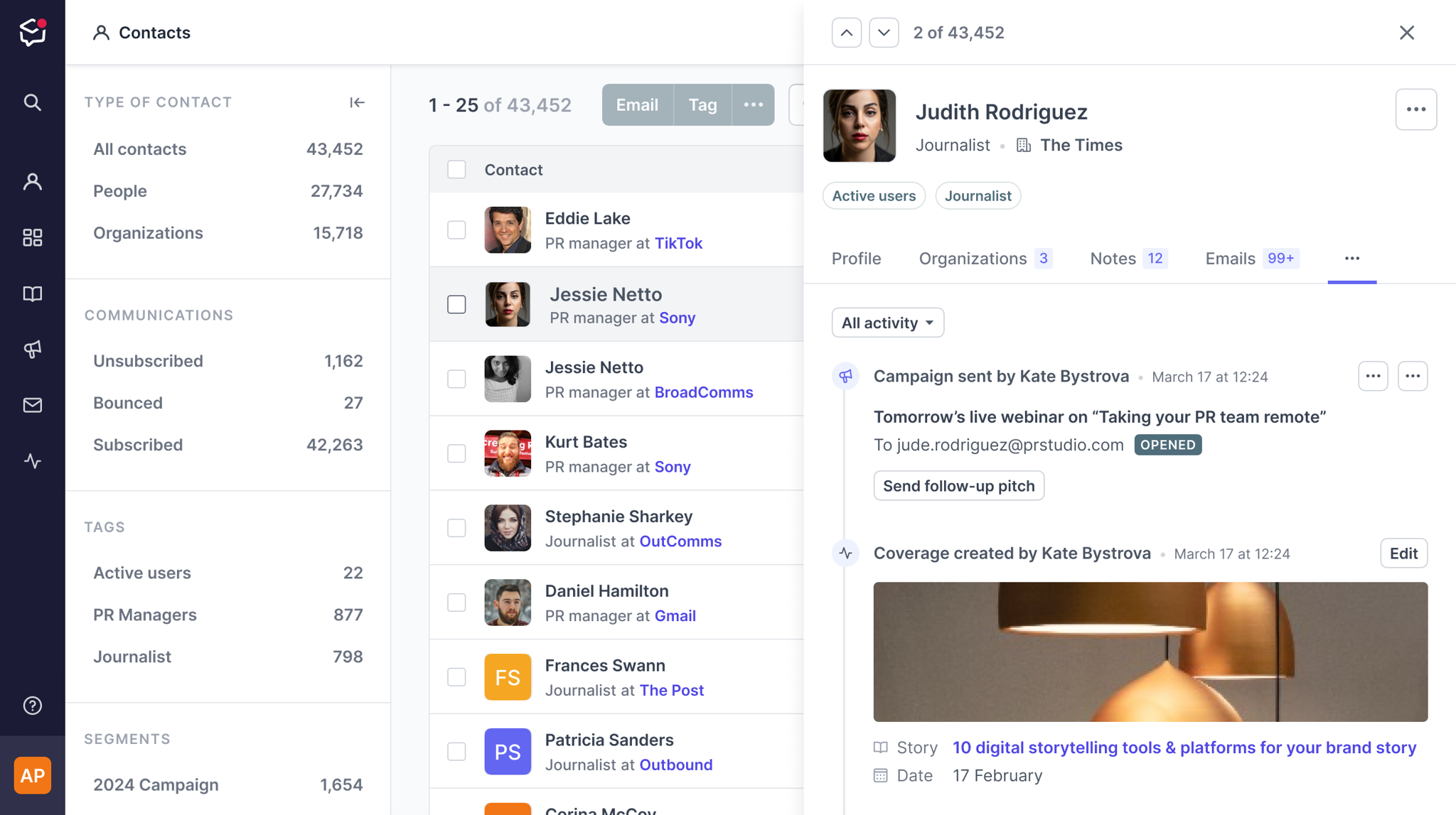
Whichever model you choose, keep control of your contacts, stories, media assets, and campaign history. Prezly's PR CRM and online newsroom software help brands and agencies collaborate without leaving the entire communications operation buried in somebody else's spreadsheets.
Manage brand and agency PR together with PrezlyA consumer PR agency should understand your buyers, category, culture, media, risks, and business stage. Start with the outcome you need, compare agencies using the same evidence, and meet the people who will actually do the work.
There is no universally best agency. There is only a best fit for the assignment, budget, market, and team you have now. Less glamorous than a top-ten trophy ceremony, admittedly, but far less likely to waste six months.
Want your PR agency featured here?
We update this list regularly. Contact us to get added.