Guide: How to Contact Journalists (And Get Covered)
You want to reach the media and get results – without annoying the people you're trying to impress. We asked them how.
There is no shortage of advice about contacting the media. Research the person you're pitching. Write a strong subject line. Personalise your email. Keep it concise.
Those recommendations are useful, but they don't address why so much PR outreach fails.
Many PR teams still work from a volume-based approach: build a large list, send broadly, and hope a small percentage of pitches generate interest. A lot of PR automation software has been built to support that workflow. The result is inboxes full of irrelevant emails, frustrated editors and reporters, and communications teams wondering why response rates keep falling.
Effective outreach starts much earlier. Success depends on identifying the right contacts, understanding what they actually cover, and sending stories that fit their audience and interests.
In this guide, we'll cover how to find media contact information, research relevant reporters and editors, write pitches worth opening, and avoid the mistakes that quietly undermine outreach efforts. The insights come from a conversation with two working media professionals – writer and editor Kelsey Ogletree and technology reporter Holly Brockwell – who shared their perspective on what gets attention and what gets ignored.
Watch the full PR Roundtable: How writers want to be pitched, or keep reading for the key takeaways.
Holly Brockwell has been on both sides of the media industry – as a media professional and as someone who has had to pitch journalists. She describes the current state of pitching without much softening:
"There's kind of a mix of people who've done lots of research and are specifically pitching to me or to the publication. Lots of people that are just pitching to everybody. And some people who, I think you can tell, didn't really want to email me."
That last category – pitches sent without a clear editorial fit – is the majority. Contacts bought from a list, pasted into a template, sent in bulk. Sometimes dressed up with a reference to their last article. Sometimes padded with a personal detail scraped from their social media that lands more creepy than charming.
Don Reisinger, who has worked in both journalism and PR, puts the core mistake plainly:
"By far the most common mistake PR pros make is that they fail to understand what the respective journalist covers, the kinds of topics they care about, and why a particular pitch has no relevance to the individual."
Most unsuccessful pitches fail long before the email is written. The real challenge is identifying the right reporters and deciding who genuinely needs to receive the story. When agencies and in-house teams are measured on output – pitches sent, contacts reached, coverage volume – the quality of each individual relationship gets sacrificed for the appearance of activity.
Journalists feel this. And they remember it.
Start by finding out how they actually want to be contacted – and then use that channel.
This sounds obvious, but it's routinely ignored in favour of whatever approach is easiest to scale. Many reporters signal their contact preferences openly. Holly keeps her email address in her bio specifically so people use it:
"That kind of bothers me when people use DMs – you can't search them by content, stuff just gets lost in there. If the email address is there, they can just email."
Kelsey Ogletree goes further: she has a "Pitch Me" page on her website with her editorial calendar and a direct contact form. She is not unusual. A meaningful number of working journalists have done something similar – posted their preferences somewhere findable – because they would rather receive relevant pitches than wade through irrelevant ones.
The practical implication: before you pitch, check their bio, their publication's contributor page, and their own website. Most will have indicated something about how they like to work. Some will have a pinned post or a note in their bio that explicitly tells you what not to do. Read it.
As a general rule:
- Email is the standard default for first contact at most publications
- Social DMs are sometimes acceptable for follow-ups, not cold pitches – and only on platforms they actively use for professional communication
- Contact forms on personal sites are a green flag; use them when they exist
- Phone calls are almost universally unwelcome unless explicitly requested
One important note: if you cannot find a media professional's contact information after reasonable effort, treat that as intentional. Some writers actively avoid being findable because they are not open to unsolicited pitches. Being a public writer does not mean being open to unsolicited outreach. Don't chase it.
Research means understanding what a reporter covers and whether your story genuinely fits – not collecting personal details to make your pitch seem warmer than it is.
Useful research looks like this:
- What beat do they cover, and how specifically? ("Tech" and "consumer wearables for the 50+ market" are very different things.)
- Which publications do they write for, and what is the editorial angle of each?
- What have they covered in the last few months that is adjacent to your story?
- Have they written anything that signals what they don't want pitched – a piece complaining about a particular type of PR approach, for instance?
- How do they prefer to be contacted? (See above.)
You can find most of this through a journalist's own website, their byline archive at a publication, or a media database. Tools like Muck Rack aggregate journalist profiles and recent work, which makes it faster to verify fit before you write anything.
What you don't need: their personal interests beyond what's professionally relevant, their location, anything from their personal social media accounts that they haven't connected to their work. Holly's response to pitches that cross this line is a useful calibration:
"You don't need to go deep diving into the journo's personal life to make a quality individualised pitch. There's a fine line between 'I did my due diligence to know your niche' and 'I know your childhood dog's favourite squeaky toy.'"
Personalisation that demonstrates you've read a writer's work and understand their beat is good. Personalisation that demonstrates you've gone through their Instagram is not.
A note on media lists: buying a contact database and blasting it is the fastest route to the kind of pitching Holly and Kelsey describe above – where the recipient can immediately tell you didn't really want to email them. Here's why we're sceptical of purchased media databases, and what a more considered alternative looks like.
Before you draft anything, make sure there's a genuine story at the centre of your pitch.
"We've launched a new product" is not a story. "We've launched something that solves a problem no one else has cracked, here is the proof, here is who it affects, and here is why your readers will care" is closer. Even then, their readers – not your brand – need to be the point.
Kelsey is direct about this distinction: pitch ideas and angles, not announcements. Her best relationships with PR people are collaborative – they come to her with an interesting angle and let her shape it into something for her audience. When people come to her expecting coverage of a press release, it rarely goes anywhere.
Before you pitch, ask yourself:
- Who does this story benefit – specifically, the reporter's readers, not your brand?
- What is the angle that makes this different from every other version of this story in circulation?
- Why does this matter now?
- What are you offering that would be difficult for the journalist to find elsewhere?
If you can't answer those cleanly, the pitch isn't ready.
Do you know what every journalist around the entire world doesn't want? This email:
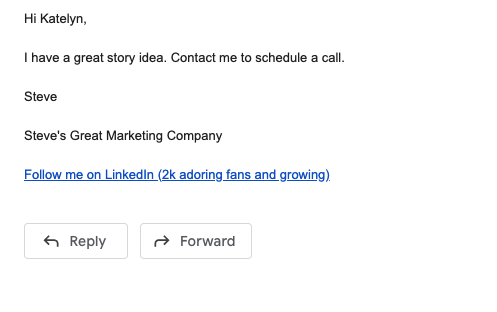
Why is this bad? Let us count the ways.
Why is this bad? The name is misspelled, there's no information about the pitch or the source, it requires follow-up just to understand what's being offered, and it wants to schedule a call. This seems hyperbolically tone-deaf, but ask any journalist and they've almost certainly received several hundred Steve-esque pitches – probably this week. Nobody wants to talk on the phone, Steve.
Once you have a story worth telling, the pitch should contain:
- A subject line with a clear, specific angle – not your company name, not a vague teaser. The journalist should be able to tell from the subject line whether this is relevant to them.
- A short pitch – two to four sentences explaining what the story is, why it matters to their audience, and why now. If you need more than that to explain it, the angle isn't sharp enough yet.
- Everything they need to write the story – quotes from relevant spokespeople, data, images, and a link to a press kit or online newsroom where they can find more. A media professional who has to chase you for the basic building blocks of a story will usually just move on.
- Your contact details – make it frictionless to follow up.
The underlying principle is straightforward: the easier you make it for a journalist to say yes, the more likely they are to. Every extra email required, every missing asset, every quote that needs to be chased is a reason for the pitch to get deprioritised. Give them a complete package.
For more on this, see our guides on writing a great pitch email and real-life examples of pitches that worked.
The journalists who are most valuable to your PR work over time are not the ones you pitch once and get a hit from. They're the ones who start reaching out to you – because they know you as a source who is worth their time.
Kelsey describes this plainly: when she has a trusted relationship with someone in PR, that relationship runs both ways. She'll look them up when she's working on a story and needs a source. The pitch becomes almost incidental.
Getting to that point requires a different approach to outreach than the volume model allows. It requires being selective about who you contact and why. It requires thoughtful follow-up, with enough context to make the conversation feel relevant and personal. And it requires accepting that your goal is to be useful to their work, not to extract coverage from them.
For a deeper look at what this means in practice, see our guide to building relationships with journalists.
A few things that follow from this:
Don't pitch outside your lane. A track record of relevant, well-targeted pitches builds credibility. Irrelevant pitches erode it. The reporter who has waded through three off-beat pitches from you is less likely to open the fourth even if it's a good one.
Accept that timing is largely out of your hands. Most journalists are not editors. They cannot guarantee when – or whether – a story runs. Pressuring them on timing, or following up aggressively after a polite non-response, damages a relationship that might otherwise have yielded something later. If timing matters to you, owned media – your newsroom, your channels – gives you the control that earned media doesn't.
A pitch that doesn't land now can land later. Kelsey notes that many media professionals archive pitches and search them when a relevant story comes up. A pitch with a clear subject line and a well-articulated angle might resurface months after you sent it, when the story finally has a hook. This is another argument against vague subject lines and long preambles.
The fundamentals are the same, but scale changes the context significantly.
The BBC is one of the highest-profile and highest-volume editorial operations in the world. Flagship programmes and news desks receive a correspondingly large number of pitches, and cold outreach to individual reporters is rarely the most effective entry point.
More reliable routes include:
- Official BBC submission and tip-off pages. The BBC maintains dedicated contact points for different programmes and departments. For news stories, there are structured routes for submitting tips and story leads. These exist specifically because the volume of unsolicited contact is unmanageable.
- Programme-specific contacts. BBC output is organised by programme and strand, and most have identifiable commissioning contacts or producers who handle external pitches. Research the specific programme rather than the network as a whole.
- Byline-level contact. If a BBC journalist has a publicly listed email – through their bio, a personal site, or their own social media – that is a legitimate route for a well-targeted pitch. Apply the same standard as you would for any other reporter: only contact them if your story is a genuine fit for what they cover.
- Building relationships over time. LinkedIn and professional networks can support this, though cold pitching via DM remains unwelcome regardless of platform.
The BBC does not have a single public-facing press contact for incoming pitches; its editorial and commissioning contacts vary by output. Research the specific area you're targeting before you try to make contact.
Some of these are repeated often enough to feel obvious – but based on what journalists report receiving, they clearly aren't obvious in practice.
Bury the lede. The first sentence of your pitch should make clear what you're pitching and why it's relevant to the writer. If they have to read through to the third paragraph to understand what you want, the pitch is going in the bin.
Send the same pitch to multiple contacts at the same publication. People in editorial teams talk to each other. When several media professionals at the same outlet compare inboxes and find the same "personalised" pitch, the damage to your credibility is significant and lasting.
Follow up aggressively. One follow-up after a reasonable wait is acceptable. Repeated chasers, guilt-laden subject lines, and "just checking in" emails sent three days apart are not. If someone hasn't responded, either the pitch didn't fit or they haven't had time. Neither is solved by pressure.
Pitch before you're ready. If you don't yet have the assets, quotes, or data to back up your story, wait. A pitch that generates interest you can't immediately fulfil is worse than no pitch at all – it burns trust at exactly the moment you've built some.
Make promises you can't keep. If you tell a journalist you can get a quote from a specific spokesperson by the end of week and you can't, that is the last pitch of yours they will open.
Treat the journalist as a means to an end. Their obligation is to their readers, not to your PR goals. Pitches that blur the line between a story and a promotional message tend to receive little attention.
We covered all of this and more in a PR Roundtable with Holly Brockwell and Kelsey Ogletree. If you want to hear it directly from them, the full session is worth an hour of your time.
Holly writes for publications including the Guardian, the BBC, and TechRadar. Kelsey covers travel and wellness for the Wall Street Journal, AARP, Condé Nast Traveler, and others. Both have seen the full range of what PR outreach looks like from the receiving end.
For more on pitching, media relations, and building coverage over time, see our guides on how to write a press release, building a press kit, PR outreach, and media relations strategy.
Published 8 July 2022, updated 12 June 2026.
About the authors
 KM
KM CE
CE

.jpg)