8 Best PR Database Software Tools (In 2026)
How to evaluate your PR database without being sold a list you'll never fully use.
Most PR database software is sold on a single number: the size of the contact list. One million journalists. Two million. More. It's an easy metric to quote, and a harder one to evaluate – because database size has almost nothing to do with whether your pitches land.
This guide covers what a media database actually does, how to evaluate it honestly, and why the tools that promise the most contacts aren't always the ones that deliver the most media coverage.
Tired of paying for generic databases where no one replies? Get a focused, relevant media list tailored to your industry, audience, and story.
This software gives communications teams access to a searchable directory of journalists, editors, bloggers, podcast hosts, and other media contacts. You filter by beat, location, outlet, or topic – and get a targeted media list of people to pitch.
Most platforms bundle this database access with other PR tools: email outreach, media monitoring, campaign tracking, and reporting. The database is usually the headline feature, but it sits inside a broader workflow suite.
The underlying premise is straightforward: find the right journalists, contact them at scale, and get coverage. In practice, the gap between that premise and what actually happens is where most PR teams lose time and money.
Scroll horizontally to see all columns. Use the arrow keys when the table is focused.
Tool | Best for | Contact coverage | Approx. price |
|---|---|---|---|
Cision | Enterprise, global campaigns | 1.7M+ traditional + social | $7,000–$20,000+/year |
Muck Rack | Modern teams, journalist research | Strong traditional | ~$5,000+/year |
Meltwater | Enterprise intelligence | Traditional + social + influencers | ~$10,000+/year |
Agility PR | Growing teams, support-heavy | Smaller, but solid | ~$3,000/year |
JournoFinder | SMBs, accuracy-first teams | 1M+, verified, real-time | From $49/month |
Roxhill | UK and European teams | Strong UK/EU editorial | Custom pricing |
Rephonic | Podcast outreach | 3M+ podcast shows | From $99/month |
Prezly | Relationship-led PR teams | Your own + curated list service | From €100/month |
The basic workflow tends to follow the same pattern across tools:
- Search – filter the database by beat, geography, outlet type, recent coverage, or audience size to build a target list
- Build – export or save those contacts into a media list within the platform
- Pitch – send personalised (or semi-personalised) emails directly from the tool
- Track – monitor open rates, clicks, follow-ups, and responses
- Report – pull campaign data to show reach, coverage earned, and media value
Where platforms differ is in the quality and freshness of their contact data, how well they integrate with your existing workflow, and whether they actually help you build relationships with journalists over time – or just make it easier to send at volume.
The standard sales pitch focuses on database size. Here's what's more worth asking about.
A database with 500,000 well-maintained, recently verified journalist contacts is more useful than one with 2 million stale records. Outdated contact information leads directly to bounced emails, unanswered pitches, and missed opportunities. Ask vendors specifically: how often is data verified? What's the typical bounce rate? How do they handle media moves – journalists who change roles or leave publications?
Cision claims more than 20,000 database updates per day. JournoFinder takes a different route, indexing published articles in real time to surface reporters actively covering a topic. The distinction affects both the contacts you find and how you find them.
An email address alone doesn't tell you much. The useful part is the context around it: recent articles, pitching preferences, beat descriptions, social profiles, job titles, and publication details. That information makes it much easier to understand what a journalist actually covers and whether your story is relevant to them. A database that only gives you a name and email address often leaves you doing the real research yourself – which largely defeats the point of paying for journalist contact information at scale.
Traditional PR databases were originally built around print and broadcast media. That coverage still matters, but many PR teams now also target podcasts, newsletters, creators, and digital-first publications. If those channels are part of your strategy, check whether the database includes them in a meaningful way, with enough detail to support actual outreach instead of surface-level categorisation.
Finding the right journalists quickly comes down to how effective the search tools actually are. Look for databases that let you filter by recent coverage, outlet type, audience size, publication date, and multiple criteria at the same time. The difference between a useful PR tool and an expensive spreadsheet often comes down to how precisely you can narrow your results.
A media database that lives in isolation from the rest of your PR workflow creates extra work at every step. Think about how it connects to your email client, your PR CRM, and your outreach tracking. Some teams want a single platform; others prefer a best-of-breed stack. Either approach is valid – but make sure the database you're evaluating actually fits how your team works.
Most enterprise PR database software costs between $3,000 and $20,000+ per year, and many platforms require long-term contracts. That's a significant budget line for most teams, and it only makes sense if you're running frequent, high-volume campaigns. Some platforms offer monthly subscription options, with some starting as low as $258/month billed annually. For smaller teams or agencies managing a handful of clients, a leaner and more targeted tool will often deliver better ROI than a full-feature enterprise suite.
Cision is the largest PR database on the market, with over 1.7 million contacts across 190 countries. It's built for scale: global campaigns, enterprise teams, multi-market outreach. For organisations running that kind of work, it covers the full workflow – database access, press release distribution via PR Newswire, media monitoring, and reporting. It's one of the most established traditional databases in the category.
The tradeoffs are well-documented: the UX feels dated compared to newer platforms, support can be slow outside enterprise-tier contracts, and pricing escalates quickly once you add users, monitoring, or additional credits. Advanced features like CisionOne AI add pitch drafting assistance and enhanced analytics, but also add to the cost.
Pricing: From ~$7,000/year for basic packages; enterprise options go significantly higher. See the full Cision pricing breakdown and our Cision reviews analysis for more detail – or if you're already looking at alternatives, our Cision competitors guide covers the main options.
Muck Rack built its reputation on journalist-first data, and that remains its strongest differentiator. The platform tracks what journalists are actually publishing and sharing in real time, which makes contact discovery and pitch targeting more precise than most alternatives. For teams focused on earned media and journalist relationship management, it's consistently rated as one of the most accurate databases available, with an intuitive interface that makes building lists and tracking media coverage straightforward.
AI Visibility Badges – flagging which journalists appear most often in AI search results – are a newer feature worth knowing about if AI search reach is part of how you're measuring PR performance.
Pricing: Custom quotes; expect a minimum of ~$5,000/year. See the full Muck Rack pricing breakdown. For a head-to-head comparison, our Muck Rack vs Cision vs Prezly article covers the key differences in detail.
Meltwater's pitch is breadth: monitoring, social listening, analytics, influencer discovery, and media database access under one roof. For enterprise teams that need deep intelligence across multiple markets, that consolidation is genuinely valuable. For teams that just need to find and pitch journalists, it's a significant platform to onboard for a relatively focused job.
Pricing: Custom; typically from ~$10,000/year depending on features and regions.
Agility PR trades database size for service quality. It won't cover niche verticals or international contacts as thoroughly as larger platforms, but it's known for strong onboarding support and more accessible pricing – which matters a lot for teams building structured outreach workflows for the first time.
Pricing: Around ~$3,000/year.
JournoFinder indexes published articles in real time instead of relying on a static contact directory. Search for a topic and you'll see journalists who have covered it recently, which makes outreach far more relevant and timely. Automatic email verification also helps reduce bounce rates, while the pricing stays accessible for smaller agencies and growing teams that don't need a large enterprise platform.
Pricing: From $49/month.
Roxhill is less well known outside the UK, but many teams pitching British and European media consider it one of the stronger regional options. Contacts are manually verified, and journalist profiles include pitching preferences, recent coverage, and social feeds alongside basic contact information. If UK or EU editorial coverage is a major part of your PR strategy, it's well worth considering.
Pricing: Custom; generally considered mid-market.
Many traditional PR databases treat podcasts as a secondary category with limited information attached. Rephonic is built specifically for podcast outreach, indexing more than 3 million shows with detailed data including estimated listener numbers, audience demographics, contact information, and episode history. For teams investing in podcast placements, it cuts down the research time significantly and makes it easier to identify shows that genuinely fit your audience.
Pricing: From $99/month.
There's a version of this that sounds counterintuitive: more contacts can make outreach harder, not easier.
When you have access to thousands of journalists on a topic, the pressure to use them is real. Lists get longer. Pitches get broader. Irrelevant pitches go out because the database made them easy to send. And journalists – who receive outreach from the same shared databases, day after day – get better at ignoring them.
Prezly's own data supports this. Pitches sent to small, targeted lists of 1–10 contacts generate 5× the clickthrough rate of sends to 200 or more. Accurate data and a well-crafted pitch to the right journalists consistently outperform a large list and a generic one.
The other limitation of shared databases is structural: you're not the only person using them. Every PR team pitching in your space has access to the same contact directories. Relevant journalists see near-identical outreach from dozens of sources. From their perspective, it's noise. From yours, it burns through goodwill on contacts you may genuinely want to build relationships with over time.
PR database software serves a clear purpose: helping teams discover relevant media contacts and expand their reach when needed. If you're entering a new market without established media relationships, a database can provide a useful starting point. It can also save significant time during large launches or campaigns that require broad outreach on a tight schedule.
The mistake is relying on the database too heavily, without a clear plan for how contacts will be researched, qualified, and maintained. For a deeper look at this argument, our article on 4 reasons you shouldn't buy a media database is worth reading before you commit to a subscription.
The strongest media contact lists are the ones your team actively maintains and uses to develop lasting media relations.
LinkedIn is genuinely useful here: many PR professionals use it to find specific outlets and journalists because users update their own profiles, meaning it can reflect media moves faster than a database waiting on its next verification cycle. Cross-referencing database entries against recent articles and LinkedIn activity before pitching is good practice regardless of which platform you're using.
When you build and manage your own media contacts:
- Every contact is someone relevant to your beat and area of coverage
- Context accumulates: who you've pitched, what you've sent, what coverage came from it
- Outreach gets more personal over time because you know who you're talking to
- You're not competing with dozens of other PR teams sending to the same directory
- Accurate information is maintained by your team, for your work – not recycled from a shared database
The upfront effort is higher. You can't generate a targeted media list of 500 journalists in five minutes. However, each campaign contributes additional relationship history, engagement data, and media knowledge, making future outreach more informed and effective. For practical guidance on building and maintaining your own list, see our media list building guide.
Prezly doesn't sell a bulk media database, and it's transparent about that. The approach is different: help PR teams build and manage their own contact lists, with the tools to make those relationships and their stories work over time.
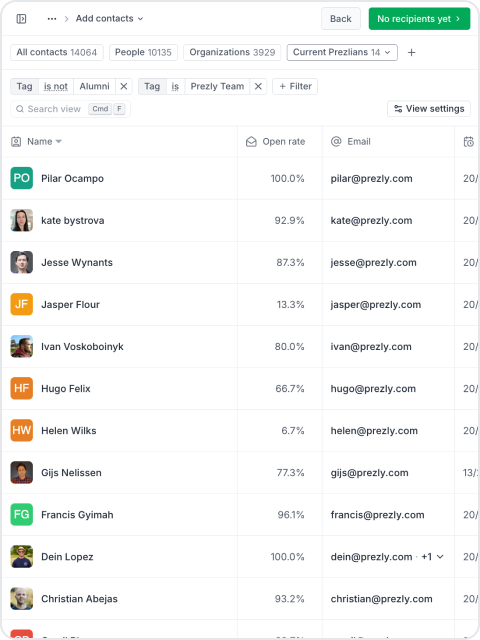
Collaborative contact management – manage and share your own media contacts across your whole team, with a full interaction history per contact: stories pitched, emails opened, media coverage earned. No more guessing who last reached out or what was said.
Curated media list building – if you need to grow your contact base, Prezly's team will research, collect, and verify media contacts relevant to your industry, audience, and story, then deliver them directly into your CRM. The result is a targeted contact list tailored to your outreach goals, with every contact reviewed and verified by a human researcher.
Email outreach with engagement tracking – send personalised pitches directly from your contacts database and see who opened, clicked, and engaged, helping teams prioritise follow-ups based on real engagement data.
Integrated newsroom publishing – alongside outreach tools, Prezly includes a public newsroom where stories remain accessible after publication. Journalists, stakeholders, and search engines can continue to discover announcements, company news, and background information long after the initial distribution.
According to Prezly's 2025 PR Performance Report, search accounts for 65% of newsroom traffic, while owned newsroom content receives 450× more AI citations than syndicated press releases. A newsroom extends the visibility of your communications and provides a permanent home for the stories your team publishes.
Pricing: From €100/month (Essential) or €250/month (Standard), billed annually. 14-day free trial, no credit card required. Already using another tool? Prezly offers a free migration service to move your existing contacts across.
For a walkthrough of Prezly's approach to media relationship management, see How to Improve Media Relations with Prezly's PR CRM.
To be fair: there are cases where buying access to a shared contact directory is the right call.
Consider it if:
- You're entering a market where you have no existing contacts and need a starting point quickly
- You're running PR across dozens of clients and need volume to justify the workflow
- You're supporting a major product launch with broad media outreach and a hard deadline
Even then, those contacts become far more valuable when they're managed in a PR CRM that preserves conversation history, engagement data, and relationship context across campaigns.
- Most PR database software is sold on contact volume – which matters far less than data freshness and accurate information
- The biggest databases share a structural limitation: you're pitching from the same lists as everyone else in your space
- Smaller, targeted lists consistently outperform large ones: Prezly's data shows pitches to 1–10 contacts generate 5× the CTR of sends to 200+
- For large enterprise teams running global campaigns, Cision and Muck Rack are the established options; Meltwater adds broader social listening and intelligence capabilities
- For accuracy-first outreach without enterprise pricing, JournoFinder is worth a look
- For UK and European editorial contacts, Roxhill leads the field
- For podcast outreach specifically, Rephonic is the most comprehensive option available
- For teams focused on building lasting media relationships instead of volume outreach, Prezly takes a different approach – relationship-led PR, owned contact data, and work that compounds instead of resetting
A PR database is a directory of journalists, editors, bloggers, podcast hosts, and other media contacts that PR professionals can search and filter to find relevant people to pitch. Most PR databases are subscription-based platforms that bundle contact discovery with outreach tools, media monitoring, and campaign reporting.
PR software is a broad category covering tools that help communications teams manage their media outreach, relationships, and coverage. It typically includes some combination of a media contacts database, email pitching tools, a newsroom or press release publisher, media monitoring, and analytics. Some platforms cover the full workflow; others specialise in one area.
Public relations covers a wide range of disciplines. The most commonly recognised types are: media relations (earned coverage through journalist outreach), crisis communications, corporate communications, internal communications, community relations, digital PR (online visibility, SEO-adjacent coverage, and link building), and influencer or content PR. Some frameworks also include investor relations and government/public affairs as distinct categories. In practice, most in-house and agency PR teams focus on a combination of media relations, digital PR, and crisis readiness.
It depends on what you're trying to do. For large-scale journalist outreach and media monitoring, Cision and Muck Rack are the most established options. For accuracy-first outreach at lower cost, JournoFinder is worth considering. For podcast placements, Rephonic leads the field. Prezly is designed for teams that prioritise media relationship management, contact ownership, and newsroom publishing within a single platform. See the full comparison above for a side-by-side view, or our 14 best PR tools guide for a broader roundup.
This is a searchable platform that gives PR teams access to journalist, editor, and media contact directories. Most platforms bundle database access with email outreach tools, media monitoring, and campaign reporting. The core purpose is to help teams find relevant journalist contacts and manage outreach at scale.
A PR database is a third-party directory of contacts you subscribe to. A PR CRM is where you manage the media relationships you've already built – tracking interactions, press releases sent, pitches, and coverage over time. Many teams use both: a database for initial contact discovery, and a CRM to manage the ongoing relationships that develop from it.
Accuracy varies significantly between platforms. Cision claims over 20,000 updates per day; Muck Rack continuously reviews journalist profiles; JournoFinder uses real-time article indexing and automatic email verification. When evaluating any platform, ask about bounce rates and verification method – update frequency alone doesn't tell you much about actual data quality.
Pricing ranges considerably. Enterprise platforms like Cision and Meltwater typically start from $7,000–$10,000+ per year, often with long-term contracts. Mid-market options like Agility PR come in around $3,000/year. Newer tools like JournoFinder start from $49/month. Prezly, which takes a different approach, starts from €100/month with a focus on owned contact management instead of shared database access. See Prezly's pricing page for current plans.
Probably not as a primary tool. Shared databases add the most value when you're entering a new market or scaling beyond your existing network. Even then, those contacts become far more useful when they're stored in a system that preserves conversation history, engagement data, and relationship context across campaigns.
For small teams, JournoFinder offers the best combination of data accuracy and accessible pricing. For UK-focused teams, Roxhill is worth considering. Teams that prioritise media relations and contact management often prefer a model built around owned contacts and curated list building. In those cases, a large shared media database may offer limited additional value.
About the authors
 CE
CE KB
KB
Build better PR, with Prezly
- Create and publish: Build beautiful press releases.
- Build relationships: Keep your contacts organized.
- Reach your audience: Send targeted pitches.