

Should press releases have images and video?
Practical guidance on press release photos, video, captions, credits, accessibility, file specifications, and journalist-ready downloads.
Yes, when the media helps explain or report the story. A useful press release image gives journalists something they can publish. A useful video demonstrates the product, captures the event, or supplies a spokesperson clip. Decoration for decoration's sake merely gives the page more things to load.
The safest default is one relevant, publication-quality image with a factual caption, credit, usage information, and an obvious download option. Add more assets when the story genuinely needs them.
In other words, press release images and press release photos should function as reporting material, not wallpaper. Press releases with photos work best when the files are relevant, reusable, and properly labelled.
This guide covers what to include, practical image and video specifications, accessibility, copyright, file delivery, and cases where text is enough.
Create a multimedia press release with PrezlyNo. A press release can work without an image when the announcement is mainly regulatory, financial, operational, or otherwise difficult to illustrate honestly.
But many stories become easier to assess and cover when you provide relevant visuals. Product launches need product photography. New hires benefit from a usable headshot. Events need venue, speaker, or previous-event images. Research announcements may need a chart that explains the strongest finding.
In Cision's reporting on its 2024 State of the Media research, 87% of surveyed journalists had used PR-provided multimedia during the previous year. That does not mean adding any image guarantees coverage. It means useful assets can save a newsroom from having to source or create them under deadline.
Ask a simple question before adding media: could an editor publish this asset with the story? If the answer is no, it may still belong on social media, but it probably does not belong in the press pack.
Choose assets according to the announcement rather than filling a gallery because the software allows it.
Provide the product on a plain background and in a realistic setting. Include several orientations or crops when the product will appear across websites, print, and social channels. Do not rely on a lifestyle image that hides the thing being launched.
Provide a current headshot with the person's full name, role, and company in the caption. If the announcement concerns a wider team or location, an environmental portrait may tell the story better than another person against a grey wall.
A staged handshake is legal, but the world has enough of them. A photograph of the people, product, locations, or work created by the partnership often carries more information.
Provide the venue, speakers, performers, or images from an earlier edition. Include dates and names in captions. If media accreditation or photography access is available, state that clearly.
Use a chart for the finding that matters most. Label the axes, sample, period, and source. Provide the underlying figures or methodology so journalists can verify the graphic rather than treating it as colourful scripture.
The Prezly press release examples gallery shows how brands use product photography, galleries, headshots, charts, and video in different types of announcements.

Example: Press contacts front and center

There is no single image size accepted by every publication or distribution service. Provide a high-resolution original and a web-ready preview, then check the requirements of any wire service or newsroom you use.
PR Newswire's current multimedia guide recommends at least 300 dpi for print and roughly 2,000 to 3,000 pixels on the longest side for digital use. Pixel dimensions matter more than writing "300 dpi" into a tiny image's metadata. A 400-pixel photograph does not become print-ready through positive thinking.
For each press release photo, provide:
- a high-resolution JPEG for photography;
- a PNG where transparency or sharp graphic elements require it;
- the original aspect ratio rather than one permanently cropped version;
- a descriptive filename such as `aster-lane-repair-portal-dashboard.jpg`;
- a short factual caption;
- the photographer or creator credit;
- usage and licensing information;
- a direct download link.
Avoid adding text to the only available image. Editors may need to crop it, translate the story, or use a different headline. Keep important facts in the page copy as well.
These three fields do different jobs.
A caption tells the reader what the image shows and why it relates to the announcement. Name people from left to right where useful, and include the place and date when they add context.
Mina Vos, product director at Aster Lane, demonstrates the repair booking portal at Cycle Works in Bristol on 3 October 2026.
The credit names the photographer, videographer, agency, or rights holder according to the agreed usage terms.
Photo: Lara Okafor / Aster Lane
Do not invent a preferred credit line after distribution. Agree on it when the asset is commissioned.
Alt text describes the content or function of an image for someone who cannot see it. Keep it concise and contextual. Avoid keyword stuffing, and do not begin every description with "image of".
A mechanic reviews a repair request on the Aster Lane dashboard beside a bicycle.
PR Newswire's press release accessibility checklist recommends alt text for images and graphics, accurate captions for video, and transcripts for audio material. If a chart contains essential text, include that information in the surrounding page copy too.
Include video when motion, sound, or a person's delivery carries information that a still image cannot.
Good uses include:
- a short product demonstration;
- footage of a process, facility, or event;
- a spokesperson statement;
- broadcast-ready b-roll;
- an animation that explains a difficult mechanism;
- a before-and-after sequence where the comparison is genuine.
A video is less useful when it repeats the press release word for word, opens with a long logo animation, or requires three minutes before reaching the announcement.

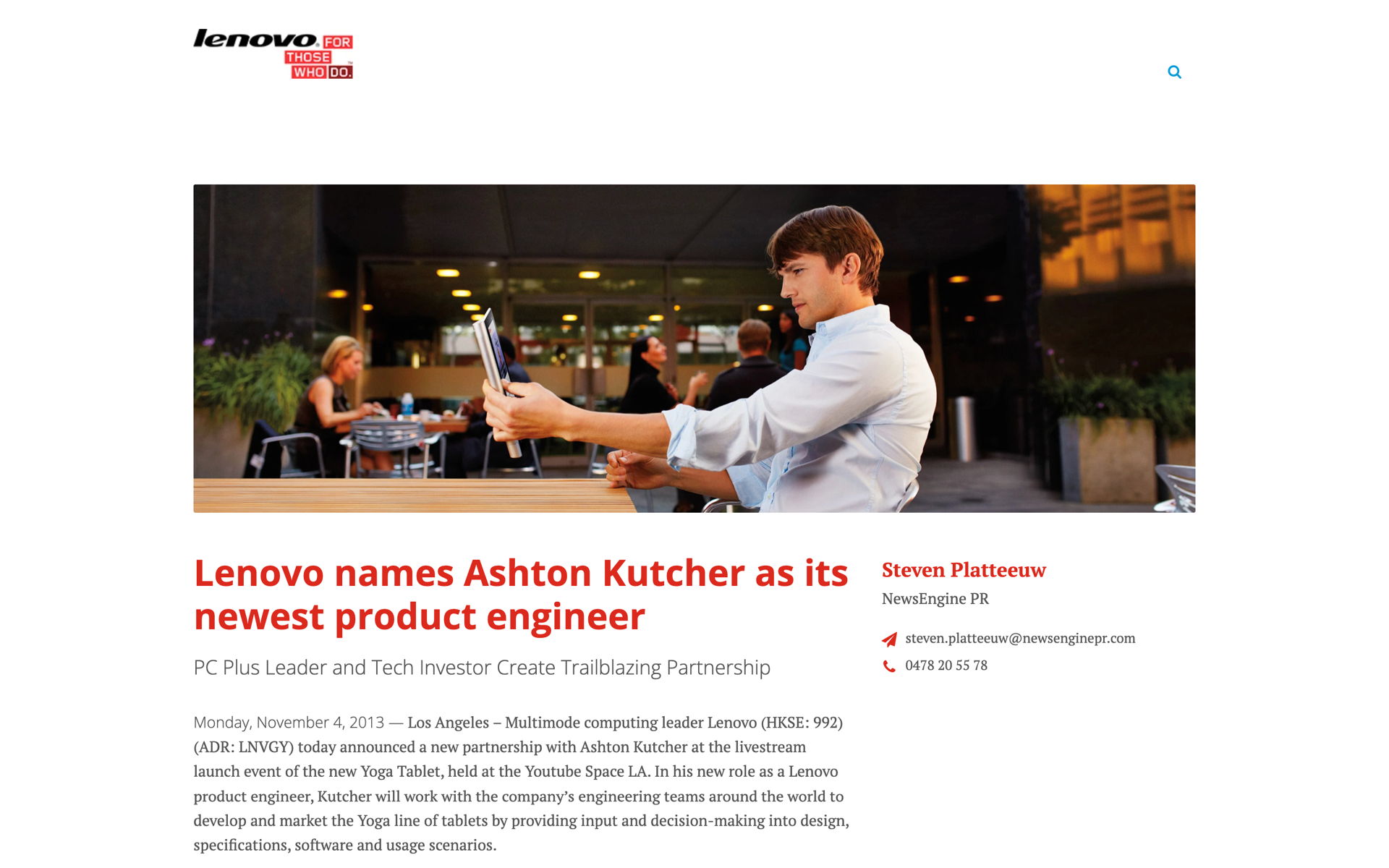
Example: Lenovo names Ashton Kutcher as its newest product engineer
Offer a playable preview and, when journalists may reuse the footage, a downloadable file. State whether editors may crop, clip, subtitle, or combine it with other material.
For general online use:
- use a widely supported format such as MP4;
- provide at least a clear HD version where possible;
- identify speakers in the video and accompanying notes;
- add accurate closed captions;
- supply a transcript;
- include a descriptive thumbnail;
- provide clean b-roll separately from a finished promotional edit when broadcasters may need it;
- include credits and usage restrictions.
Do not rely entirely on automatic captions. Names, product terms, and accents are exactly where machines tend to become freelance surrealists.
The video should also make sense without autoplay. A journalist may be opening the release in a quiet newsroom, on a train, or in the middle of a meeting they stopped listening to 20 minutes ago.
Ideally, do both.
Embed a web-ready preview in the press release so readers can understand the story without downloading files. Provide original files through a clear media gallery or press kit for journalists who need publication-quality assets.
Do not attach a folder of enormous files to a pitch email. Large attachments can be inconvenient, trigger security warnings, or affect delivery. Link to the published press release and its media gallery instead. Our guide to sending a press release email covers the pitch itself.
Keep the download path simple:
- do not require account registration;
- do not hide the download behind five navigation levels;
- do not let the link expire before the announcement does;
- do not mix approved press assets with internal drafts;
- test the link in a private browser before distribution.
Only distribute assets you have the right to share.
Before publication, confirm:
- who owns the photograph, graphic, audio, or video;
- whether the licence permits editorial reuse;
- the required credit line;
- whether identifiable people have granted the necessary permission;
- whether locations, artwork, music, trademarks, or third-party products create additional restrictions;
- how long the usage permission lasts;
- whether editing, cropping, and social use are allowed.
Stock photography can illustrate a general concept, but it is rarely a useful press asset for a company announcement. Journalists can obtain the same stock photo themselves. Original assets that document the actual product, person, location, or event are more useful.
When rights are complicated, put the terms beside the download rather than hoping everybody correctly interprets `final_approved_USE_THIS.zip`.
Leave it out when:
- the asset does not illustrate the announcement;
- you cannot verify its rights or credit;
- the image is too small or poor to publish;
- the video adds no information beyond the text;
- the visual could misrepresent a sensitive event or unverified claim;
- publishing it would expose confidential, private, or unsafe information.
A logo is acceptable when there is no meaningful editorial image, but it should not pretend to be one. You can also tell journalists that photography, interviews, or a demonstration are available on request.
Before sending the release, check that:
- the headline and opening still explain the story without the visuals;
- every image or video supports a specific part of the announcement;
- high-resolution originals are available to download;
- previews load quickly and work on mobile;
- filenames are descriptive;
- people, locations, products, and dates are identified correctly;
- captions and credits are included;
- usage rights are explicit;
- image alt text is useful;
- video captions and transcripts are accurate;
- charts name their source, sample, period, and methodology;
- the media contact can answer asset and rights questions;
- links, embeds, and downloads have been tested;
- the release remains readable if an embed fails.
A multimedia press release is not automatically a better press release. The useful version gives journalists accurate, relevant assets without making them chase permissions, decode filenames, or request a larger copy by email.
With Prezly's press release software, you can publish images, galleries, video, audio, contacts, and downloadable files with the story, then send journalists one link rather than a small landslide of attachments.
Create a multimedia press release with Prezly
Build better PR, with Prezly
- Create and publish: Build beautiful press releases.
- Build relationships: Keep your contacts organized.
- Reach your audience: Send targeted pitches.
